You already know you should move more. You have known for years. You have a gym membership you feel guilty about, a standing desk that is permanently in the sitting position, and a mental note to start jogging that gets rolled over to next Monday every week.
What if the problem is not motivation? What if the problem is that we have been thinking about exercise completely wrong?
The model most of us were sold — thirty to sixty minutes of sustained moderate-to-vigorous activity, five times a week — is real and valuable. But it is not the only lever. And for the vast majority of knowledge workers who spend eight hours a day at a desk, it is not even the most important one.
The research on exercise snacking changes everything.
What Is Exercise Snacking?
Exercise snacking is not a diet trend. It is a scientific framework.
The term refers to the practice of breaking up prolonged sedentary periods with very short, frequent bursts of physical activity — typically one to five minutes, multiple times throughout the day. Rather than one discrete workout session, you scatter movement across your hours like snacks between meals.
The concept emerged from a growing body of research showing that the pattern of physical activity matters as much as the total volume. Three ten-minute movement bouts spread through the day produce meaningfully different physiological and cognitive outcomes than one thirty-minute session bookended by six hours of uninterrupted sitting.
The human body was not designed to sit still for hours. It was designed to move constantly and rest intermittently. Exercise snacking attempts to restore something closer to that ancestral pattern within the constraints of modern desk work.
The Science: What Happens in Your Brain During a Micro-Workout
When you stand up and do fifteen squats, something specific happens in your brain within minutes.
Blood flow to the prefrontal cortex — the region responsible for focus, decision-making, and working memory — increases. Dopamine and norepinephrine are released, improving mood and sharpening attention. BDNF, sometimes called "Miracle-Gro for the brain," spikes briefly. This neurotrophic protein supports the survival and growth of neurons and plays a direct role in learning and cognitive performance.
A 2024 meta-analysis in the British Journal of Sports Medicine examined twenty-five randomised controlled trials and found that interrupting continuous sedentary time with multiple short physical activity bouts improved cognitive function across all measured domains — attention, executive function, and working memory. The effect was significant even when the exercise bouts were as short as three minutes.
A separate study published in npj Mental Health Research used a within-person causal design — a rigorous approach that controls for individual variation — and found that brief sedentary breaks involving light physical activity produced measurable improvements in both energetic arousal and mood valence in daily life.
You are not just burning calories. You are chemically changing the state of your brain.
Why Small Doses Work
The mechanism that makes exercise snacking effective is not about cardiovascular fitness. It is about metabolic signalling.
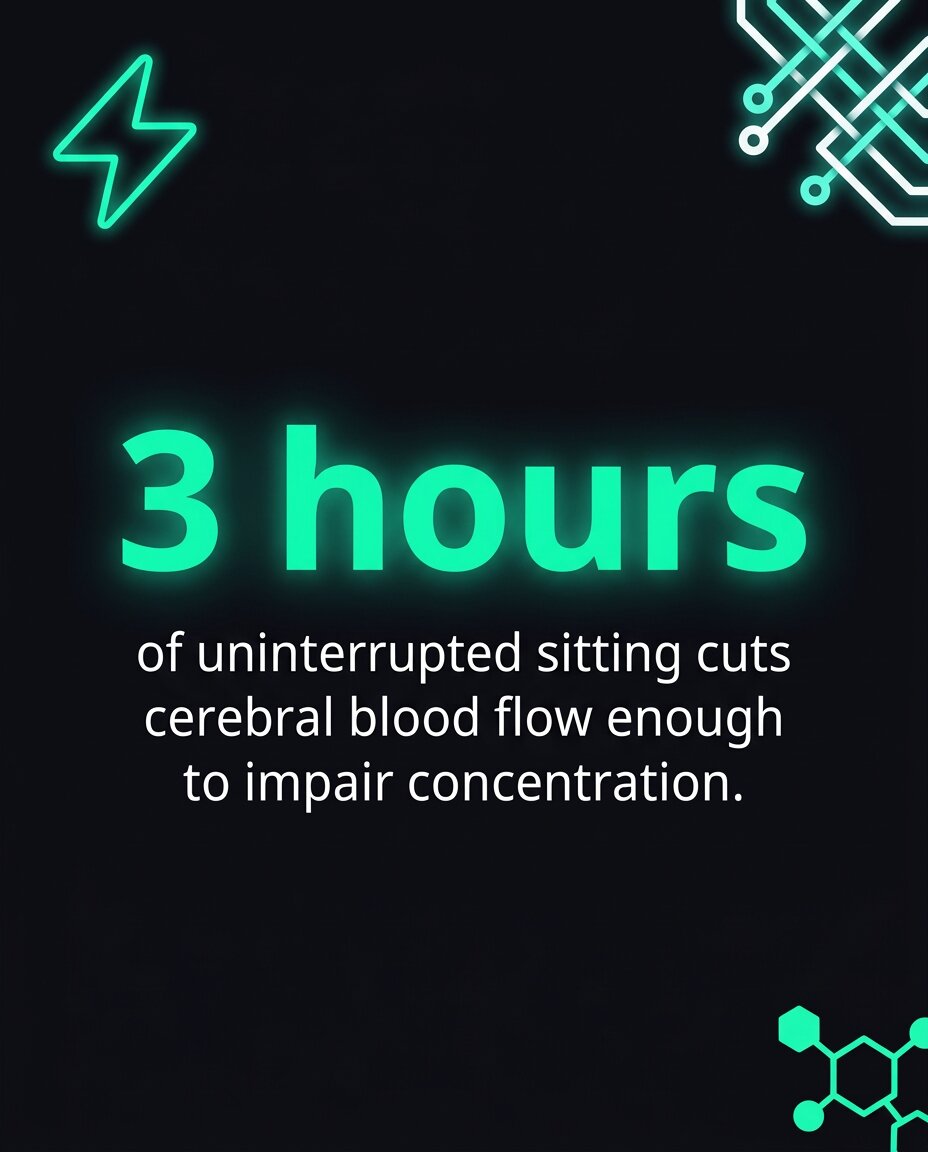
When you sit for extended periods, a specific enzyme called lipoprotein lipase — responsible for processing fats and regulating blood sugar — essentially switches off in your leg muscles. This happens within hours of continuous sitting, independent of whether you exercised that morning. The inactivity itself is the trigger.
Breaking up sitting time — even briefly — reactivates this enzyme, restores blood glucose regulation, and reverses the cascade of physiological effects that prolonged stillness initiates. This is why research consistently shows that exercise snacking produces metabolic and cognitive benefits that are distinct from, and additive to, structured exercise sessions.
In other words: your morning run does not undo six hours of sitting. But ten two-minute movement breaks scattered through your day do something your run cannot.
What Counts as an Exercise Snack?
Almost any movement that gets your heart rate slightly elevated and your muscles briefly engaged qualifies. The bar is lower than you think.
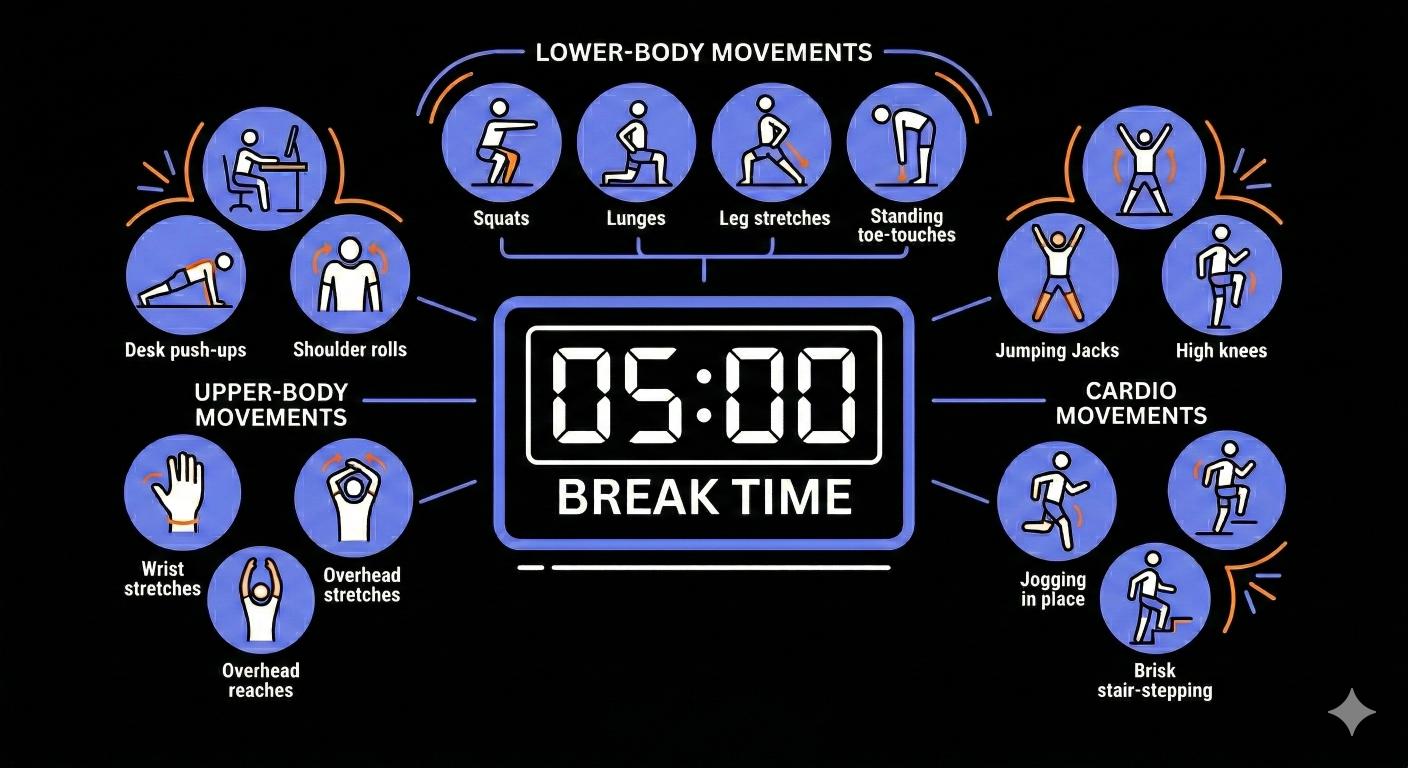
High-yield exercise snacks for desk workers:
- 12–15 bodyweight squats (targets the largest muscle group in your body, maximising blood flow impact)
- 10 push-ups (upper body reset after hours of forward-leaning screen posture)
- 20 jumping jacks (fast heart rate spike, full-body circulation boost)
- 45-second wall sit (isometric hold, no noise, suitable for open offices)
- Hip flexor stretch held for 30 seconds each side (directly counteracts the shortening caused by sitting)
- 15 calf raises (improves circulation from the legs back to the heart)
- Neck rolls and shoulder circles (targets the exact tension pattern desk work creates)
None of these require equipment. None require a change of clothes. Most take under ninety seconds. All of them produce measurable physiological effects if done consistently throughout the day.
The Compounding Effect
Here is where exercise snacking becomes genuinely powerful.
One micro-workout produces a transient neurochemical boost. Five micro-workouts spread across a workday produce something closer to a sustained state of elevated cognitive performance.
Each movement break resets the sedentary clock, prevents the progressive accumulation of the cognitive and metabolic damage that prolonged sitting causes, and ensures you arrive at 5PM with a meaningfully different physiological state than if you had sat still since 9AM.
Researchers studying this pattern have found that consistent exercise snacking — even just two to three brief bouts per day — is associated with lower fatigue scores, better mood, and sustained attention scores in the afternoon, the exact window when desk worker performance typically craters.
The goal is not one good workout. The goal is a day that never fully stagnates.
Start building your movement habit today.
Try PomoFit Free — Active Breaks Included
How to Actually Make It Happen
The universal challenge with exercise snacking is that you forget. You get deep into work, two hours evaporate, and you look up to find you have not moved since your morning coffee.
This is not a willpower problem. It is a systems problem. The movement needs to be triggered by something reliable, not remembered through intention.
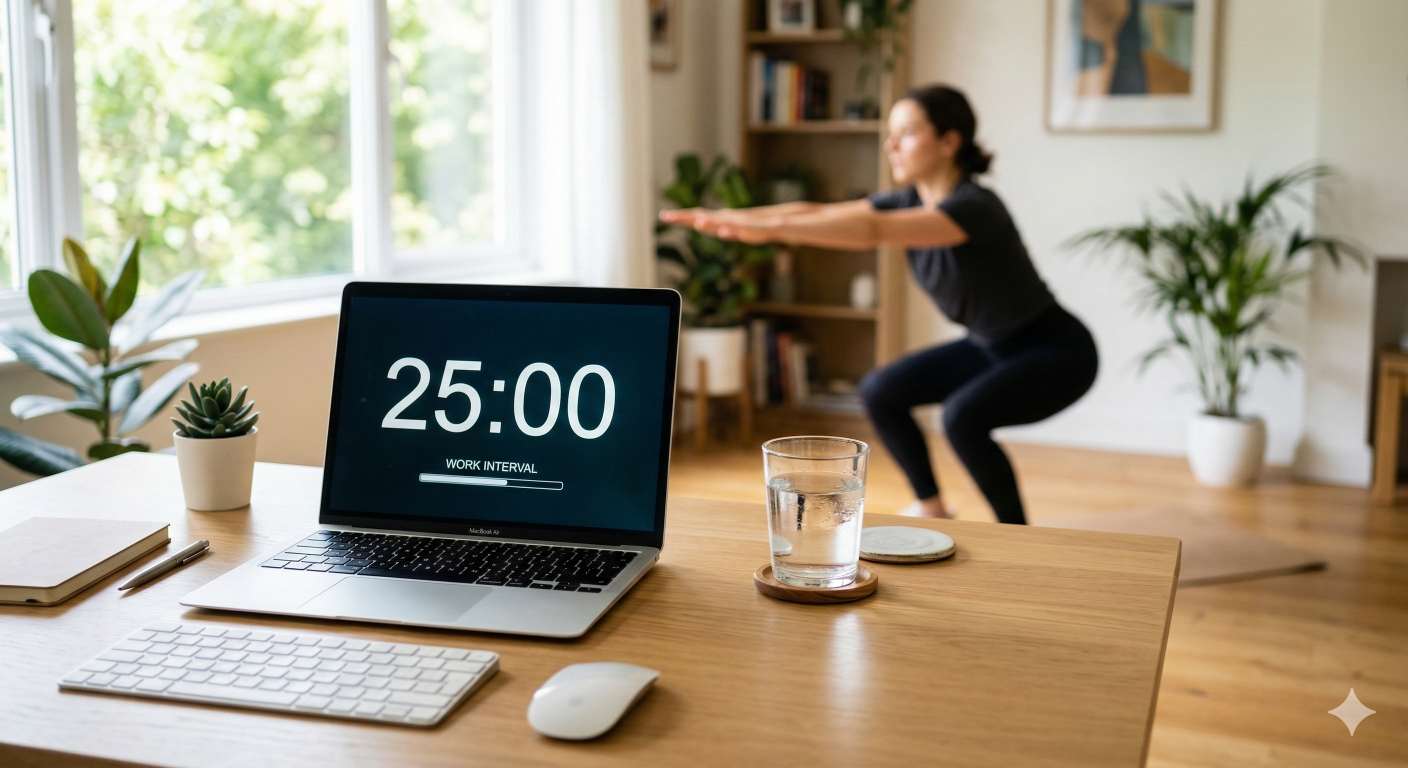
The most effective trigger is a timed break built into your work structure — specifically, the end of a focused work block. If your work is already structured in intervals, the break becomes the natural and automatic moment for a micro-workout. You do not decide to exercise. The timer decides for you.
This is exactly how PomoFit works. Every 25-minute focus session ends with an auto-assigned exercise break — the specific movement, the rep count, the timer. There is no decision to make and no gap for passive scrolling to fill. You finish your focus block, you do your exercise snack, and you go back in.
Over a standard eight-hour workday, that is eight to ten micro-workouts built in automatically. No gym. No workout clothes. No extra time carved out of your schedule.
Exercise snacking works. The missing piece was never motivation — it was the system.