I want to tell you about the week I genuinely thought the Pomodoro technique was broken.
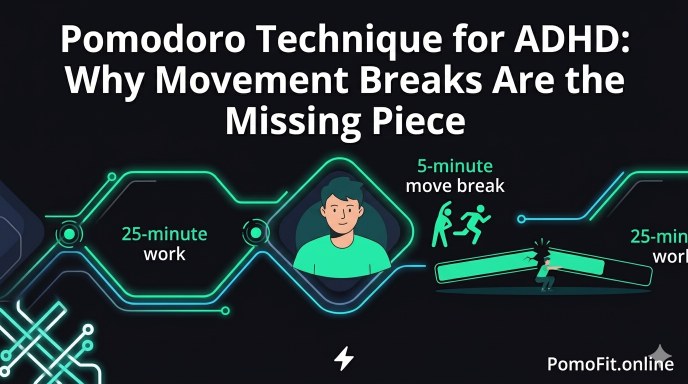
I had read about it everywhere. Twenty-five minutes of focused work, five-minute break, repeat. Simple. Structured. Supposedly the holy grail for people whose brains won't sit still. I set up a timer, picked a task, and started.
The first session went reasonably well. The second one, I spent the last seven minutes watching the timer. By the third, I had opened six tabs, checked my phone twice, and completely forgotten what I was supposed to be working on.
The timer was not broken. The breaks were.
Why the Standard Pomodoro Technique Struggles with ADHD
The Pomodoro technique was designed for a brain that can use a passive rest period to genuinely rest — then smoothly re-engage with focused work.
That is not how ADHD works.
When an ADHD brain hits an unstructured break, it does not idle. It seeks. It scans for stimulation. It finds your phone, a stray thought, an interesting notification, or the very compelling question of whether you have ever actually looked up how cheese is made. Five minutes becomes twenty-five. The momentum you built during the focus session evaporates completely.
The problem is not with the work interval. The research on structured timeboxing for ADHD is actually solid — a 2020 systematic review in the Journal of Attention Disorders found moderate to strong evidence for techniques involving explicit time boundaries, and participants rated Pomodoro as "significantly more sustainable" than GTD or traditional to-do lists. The technique works. The passive break is the sabotage.
The ADHD brain does not need a rest during breaks. It needs a different kind of stimulation.
The Neuroscience of Why This Matters
Here is what is actually happening when an ADHD brain hits a wall.
ADHD is fundamentally characterised by dysregulation of dopamine and norepinephrine — the neurotransmitters responsible for motivation, focus, sustained attention, and the ability to initiate and complete tasks. This is not a character flaw or a lack of effort. It is a documented difference in how these systems function.
When you finish a focus session and sit passively, dopamine levels — already lower at baseline for many people with ADHD — drop further. The absence of stimulation creates an aversion. Your brain actively tries to escape it. This is why passive break time almost always turns into phone time, which triggers a dopamine spike that makes re-engaging with work feel comparatively awful.
Now consider what happens when the break involves physical movement.
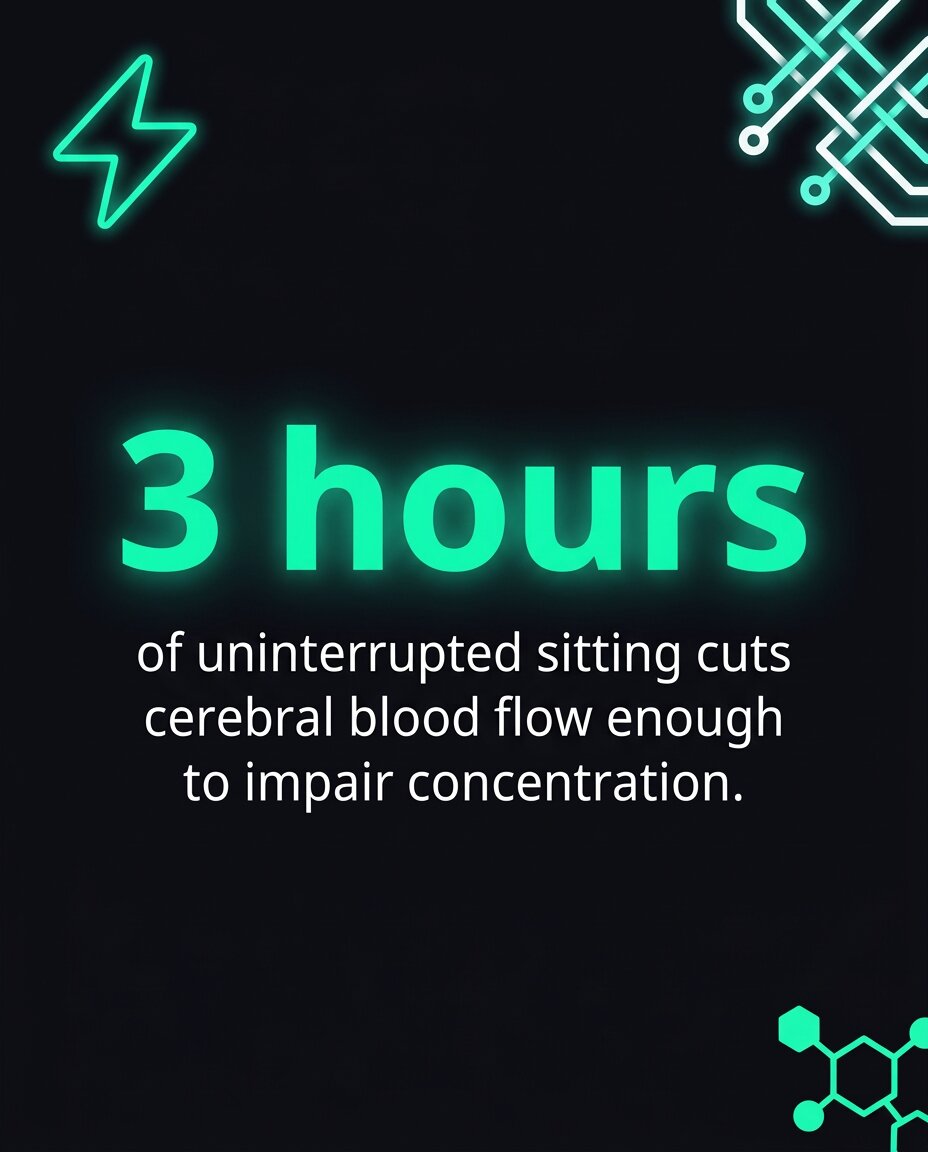
Even five minutes of bodyweight squats, jumping jacks, or push-ups triggers a genuine neurochemical response. Dopamine and norepinephrine are released. Heart rate elevates briefly. Blood flow increases to the prefrontal cortex — the region most implicated in ADHD executive dysfunction. Research from Dr. John Ratey, author of Spark and a leading voice on exercise and the ADHD brain, describes this as a dose of the brain's own medication.
You finish the break with elevated dopamine, not depleted. You re-enter the next focus block primed, not dragging.
This is not a motivational reframe. It is the correct neurochemical sequence for an ADHD brain to sustain productive work.
The Time Blindness Problem — and How Structure Solves It
Time blindness is one of the most disabling and least discussed aspects of ADHD. The inability to feel time passing — to intuitively sense that five minutes have elapsed, or that it is already 3PM — is not a quirk. It is a clinically documented feature of how ADHD affects temporal processing.
This makes unstructured breaks dangerous in a very specific way. You intended to take five minutes. You have no reliable internal sense of duration. Forty minutes later, you surface from a YouTube rabbit hole with a vague sense that something went wrong.
The solution is not more willpower. It is external time structure that does not depend on your internal clock.
This is exactly what a timed, active break provides. The break has a defined activity — twelve squats, ten push-ups, twenty jumping jacks. The activity has a natural endpoint. A timer marks its duration. You are never in the position of having to guess when it is over, because the structure tells you.
For ADHD, the break needs to be as structured as the work. Leaving either one open-ended is where the day falls apart.
Finding Your ADHD Pomodoro Interval
The classic twenty-five-minute session was designed for a generalised knowledge worker. It is a reasonable default, but it is not a law.
Many people with ADHD find that shorter initial intervals — fifteen to twenty minutes — work better, at least to begin with. The goal is to end each session feeling successful, not burned out. A fifteen-minute session you genuinely complete and return from is worth more than a twenty-five-minute session you spend staring at a wall for the last eight minutes.
Over time, as the habit of active breaks builds the re-engagement muscle, many people find they can extend their intervals naturally. Start short. Build from success.
It is also worth noting that ADHD focus is non-linear. Some days, forty-five-minute intervals feel effortless. Other days, fifteen is the ceiling. A good Pomodoro setup for ADHD adapts to this — it does not punish you for adjusting.
What the Active Break Actually Looks Like
The exercise does not need to be elaborate. The threshold for neurochemical effect is lower than most people assume.
A useful ADHD break exercise has three qualities: it is physical enough to elevate heart rate slightly, it is specific enough that you do not have to decide what to do, and it is short enough that it does not feel like another task.
- Twelve bodyweight squats
- Ten push-ups
- Twenty jumping jacks
- A thirty-second sprint on the spot
These tick all three boxes. You do not need a gym, workout clothes, or any equipment. You need a body and thirty square centimetres of floor space.
The specificity matters particularly for ADHD. Decision fatigue is real, and the blank break — "go do something healthy for five minutes" — requires a decision your executive function may not be ready to make mid-session. The break needs to be pre-decided, queued, and waiting.
Try This Right Now
If you have a task in front of you, set a timer for fifteen minutes and work on it. When the timer goes off, do this:
- Stand up from your chair.
- Do twelve bodyweight squats — slow, deliberate, feet shoulder-width apart.
- Do ten push-ups, or as many as you can manage.
- Take three slow breaths.
Notice what the transition back to your desk feels like compared to a passive break. Notice whether the task feels more or less approachable.
That is the neurochemical shift in action.
Ready to try Pomodoro with breaks that actually work?
Start your first session free — no signup needed
How PomoFit Makes This Automatic
The hardest part of this for ADHD is consistency. Knowing what to do during a break is one thing. Actually doing it, across every session, on the days when motivation is low and the phone is right there — that is where the habit usually collapses.
PomoFit solves this by removing the decision entirely. Every focus session ends with an automatically assigned exercise. The specific movement, the rep count, the break timer — it is all pre-loaded before you even finish the session. You do not choose. You do not decide. You just follow the structure.
For an ADHD brain, this is not a small thing. Removing the executive function demand from the break means the break happens — consistently, correctly, and without a spiral into passive stimulation.
The best Pomodoro system for ADHD is one that manages the breaks as precisely as the focus sessions. That is what PomoFit does.