It is 2:40 PM and you are on your fourth coffee of the day.
You know, even as you drink it, that this one is a mistake. You will not sleep well tonight. Tomorrow you will be more tired than today, which means you will need more coffee tomorrow to get through the same afternoon wall. You are borrowing against yourself and paying compound interest.
The thing is — you are not reaching for coffee because you lack willpower. You are reaching for it because it works, at least in the short term, and because nobody gave you a better option.
This is the better option.
Why Coffee Is the Wrong Tool for the Afternoon Slump
Caffeine does not restore energy. It borrows it.
The specific mechanism: caffeine works by blocking adenosine receptors in your brain. Adenosine is the chemical that accumulates throughout the day and creates the progressive sensation of fatigue — the sleep pressure signal your body uses to tell you it is time to rest. When you drink coffee, caffeine sits in those receptors and prevents adenosine from binding. You stop feeling tired.
But the adenosine does not disappear. It keeps accumulating while the caffeine is blocking the signal. When the caffeine wears off — typically four to six hours later — the adenosine that built up during that window floods back in all at once. The crash is often worse than the slump you were trying to avoid.
Afternoon caffeine also delays sleep onset and degrades sleep quality. Which means you wake up the next day with more accumulated sleep debt, a more severe afternoon dip, and a stronger craving for another afternoon coffee. It is a cycle that makes the underlying problem progressively worse.
Caffeine delays the crash. Movement eliminates it.
What Is Actually Causing the Afternoon Slump
Before we get to the fix, it is worth understanding what we are actually working with — because the afternoon slump is not one thing, it is two things compounding.
The first is your circadian rhythm. Your body runs on a 24-hour internal clock, and that clock has two low-energy windows built in: the nighttime sleep window, and a smaller secondary dip in the early afternoon — typically between 1PM and 3PM. This dip occurs regardless of how much you slept, what you ate for lunch, or how productive your morning was. It is hardwired biology, likely a vestige of the biphasic sleep patterns common in warmer climates and many traditional cultures.
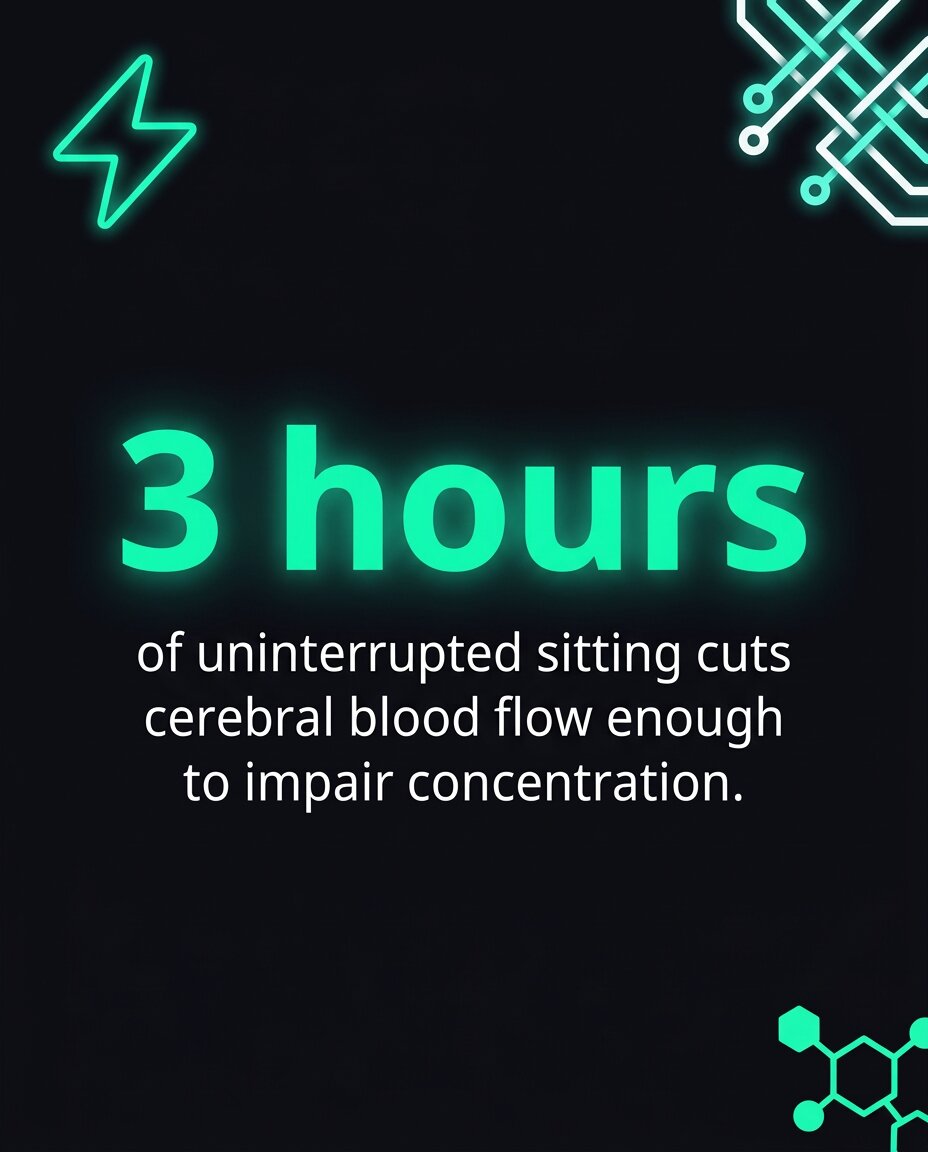
The second is physical stagnation. If you have been sitting at a desk since nine in the morning, you arrive at the 2PM circadian dip with already-reduced cerebral blood flow, depleted BDNF levels, and accumulated adenosine from hours of cognitive work. The dip lands on a body that has no reserves left to absorb it.
These two effects compound. The circadian biology produces a manageable dip in someone who has been moving regularly throughout the day. In a sedentary desk worker, it produces the full wall — the feeling of wet concrete in the brain, the rereading of the same paragraph, the staring at a screen while producing nothing.
Coffee addresses neither cause. It patches the symptom while both causes continue accumulating.
The Movement Protocol
This protocol is built around three principles from the circadian and exercise science research. First, movement breaks are most effective when they occur before the dip fully lands — not as a rescue measure once you are already deep in fog. Second, the exercise intensity needs to be sufficient to meaningfully elevate heart rate and blood flow, but not so intense that it requires recovery time. Third, consistency across the whole day matters more than any single break.
From 9AM — build the foundation
The most important thing you can do to reduce the severity of the afternoon slump is to ensure you are not arriving at 2PM with six unbroken hours of sitting behind you.
Use the morning to establish a movement break habit. A structured Pomodoro timer with active breaks achieves this automatically — every twenty-five minutes of focused work followed by five minutes of physical movement. Squats, push-ups, jumping jacks, stretches. By the time 1PM arrives, you have completed four to six mini-workouts without having disrupted your morning work at all.
At 12PM — eat strategically
Lunch significantly affects the severity of the afternoon dip. A high-carbohydrate meal triggers a cascade of insulin, tryptophan, serotonin, and melatonin that deepens the circadian trough. It does not cause the dip — but it amplifies it.
A protein-rich, lower-glycaemic lunch flattens this spike. Chicken, eggs, fish, legumes, vegetables. Smaller portions spread across lunch and a mid-afternoon snack maintain more stable energy than one large meal. This will not eliminate the dip, but it meaningfully reduces its depth.
At 1:30PM — the pre-emptive strike
This is the critical window. The circadian dip typically lands between 1PM and 3PM, but the worst subjective experience usually hits around 2PM to 2:30PM. If you wait until you feel the fog to respond, you are already behind it.
At 1:30PM — or at the end of your last focus session before 2PM — do a deliberate, slightly more intense movement break than your standard between-session exercise.
The protocol:
- Twenty bodyweight squats, controlled tempo
- Fifteen push-ups (or wall push-ups if needed)
- Twenty jumping jacks
- Thirty-second standing hip flexor stretch, each side
- Three slow nasal breaths
This takes under four minutes. The combination of lower-body compound movement (squats), upper-body push (push-ups), full-body cardio (jumping jacks), and hip flexor mobility (targeting the specific shortening that hours of sitting causes) produces the most comprehensive blood flow response in the shortest time.
At 2PM to 3PM — work with the biology, not against it
The circadian trough is real and it cannot be fully eliminated. What you can control is what you put in that window.
Reserve this period for lower-cognitive-demand tasks: email, administrative work, scheduling, reading, responding to messages, organising files. Do not put your hardest thinking or most important decisions in the 2PM to 3PM window. This is not giving up — it is intelligent scheduling. Every high performer who manages their energy rather than their time does this instinctively.
If your schedule allows, a ten-to-twenty-minute rest at 1PM — not sleep, just eyes closed and horizontal — is the single most evidence-backed intervention for the afternoon dip. The research on brief naps and post-lunch rest is unambiguous. If your work environment makes this impossible, even five minutes of eyes-closed breathing at your desk produces a partial version of the effect.
At 3PM — the second wind
Something interesting happens after the trough. For most people, there is a genuine second wind between 3PM and 5PM — a natural rebound in alertness and cognitive performance as the circadian cycle turns upward again.
This window is frequently wasted because the damage from a passive 2PM has already been done — coffee crash, phone spiral, thirty minutes of unproductive staring. People arrive at 3PM too depleted to take advantage of the rebound.
If you have managed the 1PM to 3PM window well — light work, a deliberate movement break, no catastrophic caffeine — you arrive at 3PM capable of another two to three focused Pomodoro sessions. That is two to three hours of recovered productive time that most desk workers write off entirely.
This is where the protocol compounds. The afternoon is not lost time. It is mismanaged time.
Why This Works When Coffee Doesn't
The mechanism is worth stating plainly.
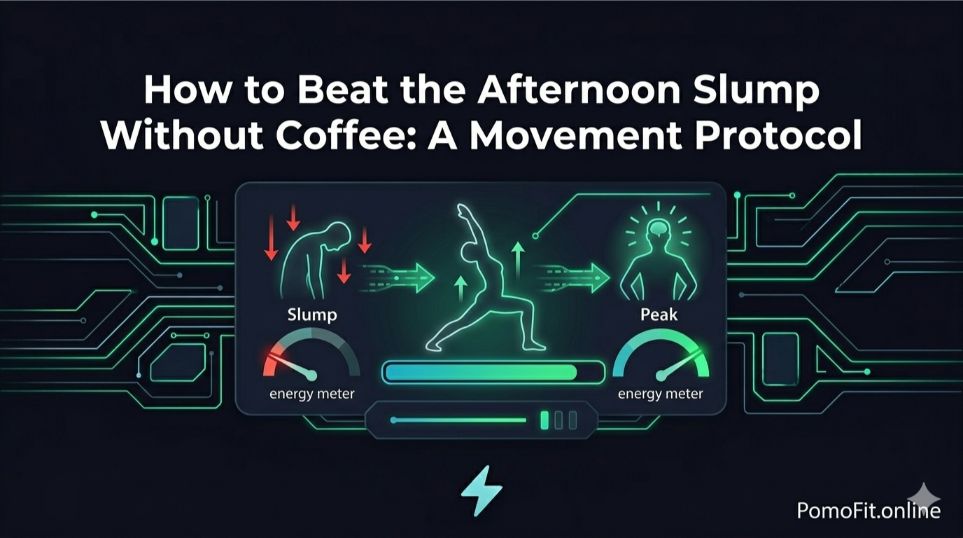
Movement directly addresses both causes of the afternoon slump simultaneously. Physical activity increases cerebral blood flow — restoring the oxygen delivery that prolonged sitting has reduced. It triggers release of dopamine, norepinephrine, and BDNF — the same neurochemicals that both sustain alertness and counteract adenosine-driven fatigue. And unlike caffeine, it does not borrow against tomorrow.
A 2024 study in npj Mental Health Research confirmed that even three minutes of physical activity during sedentary periods produced significant improvements in energetic arousal and mood — the exact parameters that define the afternoon slump experience. The effect is not hypothetical. It is measurable, reproducible, and takes minutes.
Build the afternoon you actually want — starting today.
Try PomoFit free — active breaks included
Making It Automatic
The protocol described above requires consistency to work. And consistency requires that the breaks happen whether or not you remember to take them, whether or not you feel like it, and whether or not your next task is demanding enough that stopping feels impossible.
This is precisely the function of a structured active break timer. PomoFit builds movement breaks into the architecture of your working day — automatically assigned, timed, and queued before you need to make any decision about them. The pre-2PM break happens because the system scheduled it. The 3PM second wind is available because the system kept you moving all day.
You do not fight the afternoon slump. You make it irrelevant.