There is a statistic that stopped me cold when I first read it.
Office workers sit, on average, between six and nine hours a day. That figure includes people who consider themselves active. People who go to the gym. People who take the stairs. People who would never describe themselves as sedentary.
The reason it stopped me is not the number itself. It is the qualifier buried in the research: the cognitive and metabolic damage of prolonged sitting accumulates independently of how much you exercise outside of work. Your morning run does not cancel out eight hours in a chair.
This is not a lifestyle critique. It is a specific biological mechanism — and once you understand it, the afternoon fog, the decision fatigue, and the inexplicable exhaustion that lands at 3PM all make a very different kind of sense.
What "Prolonged Sitting" Actually Means
We need to be precise here, because vague definitions produce vague responses.
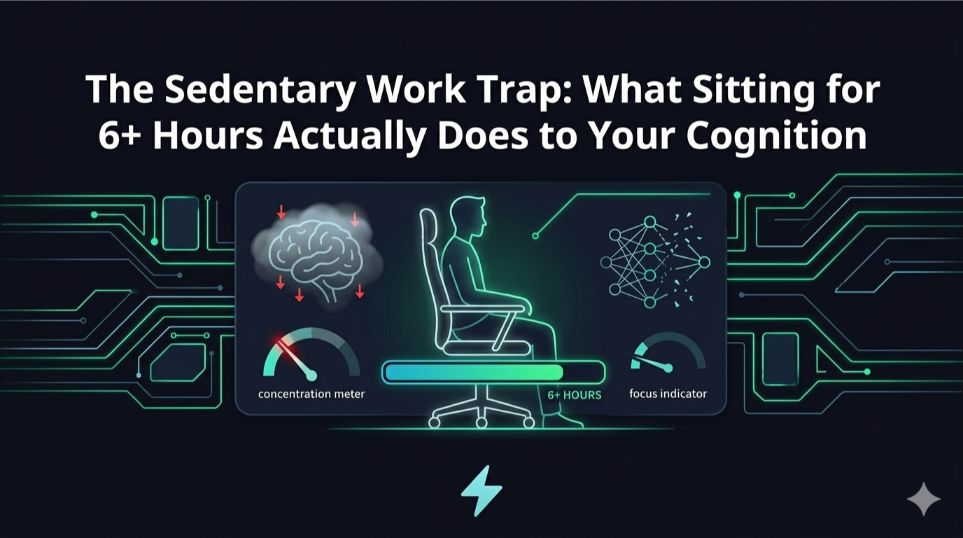
Prolonged sitting, in the research context, refers to unbroken periods of sedentary behaviour exceeding thirty to sixty minutes. Not total daily sitting time — unbroken duration. This distinction matters enormously. Six thirty-minute sessions of sitting with movement breaks in between produce measurably different physiological outcomes to three two-hour blocks of uninterrupted sitting, even if the total time is identical.
The body does not care how long you sat today. It responds to how long you sat without moving.
Most desk workers, in practice, have very few natural movement triggers during a workday. You sit down at your desk at nine. The first reason to stand up might be a meeting at eleven. That is a two-hour block. After the meeting, you sit again. Another two hours until lunch. After lunch — you sit again. By 3PM, you have had perhaps three or four genuine breaks from your chair across a six-hour morning, and none of them involved meaningful physical movement.
This is what the research on sedentary behaviour is actually measuring. Not total sitting time. The unbroken accumulation of stillness.
The Biological Chain of Events
When you sit still for an extended period, something specific happens at a cellular level that has nothing to do with how fit you are.
Within the first hour of continuous sitting, an enzyme called lipoprotein lipase — responsible for processing fats and regulating blood glucose in your leg muscles — begins to suppress. This happens independently of your overall fitness level. The mechanism is not about cardiovascular health or muscle mass. It is a direct response to the absence of muscular contraction in your legs, which your body interprets as a signal to shut down certain metabolic processes.
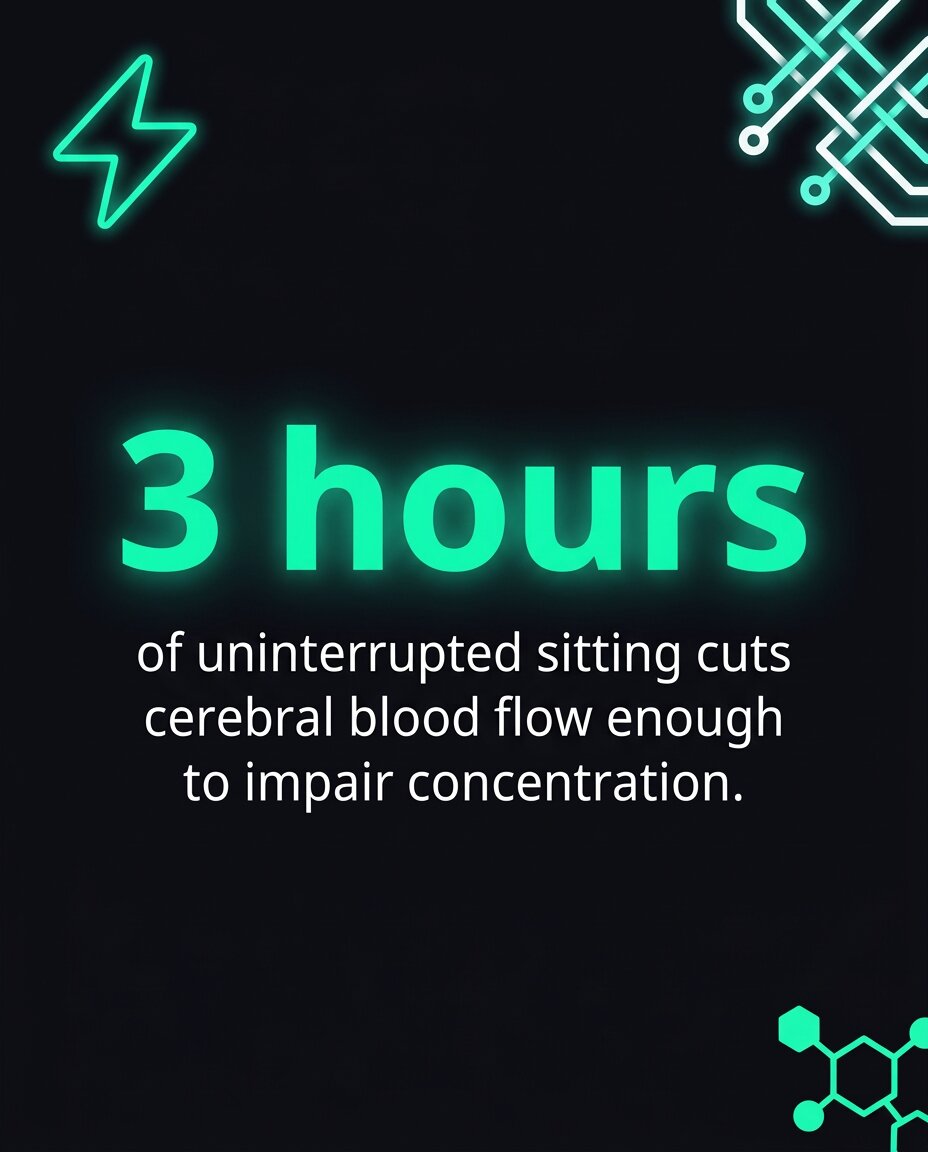
Simultaneously, blood flow begins to slow. Circulation to the brain — particularly to the prefrontal cortex, the region governing attention, decision-making, and working memory — decreases measurably. Oxygen delivery drops. Carbon dioxide clearance slows.
By the ninety-minute mark, research from Curtin University found that cognitive performance in sustained attention and creative problem-solving had measurably deteriorated. This is not subjective tiredness. It is a documented decline in the quality of the work being produced — more errors, slower processing, reduced creative output — even in people who feel like they are working normally.
You cannot feel your cognitive performance declining. That is what makes the sedentary work trap so effective at catching people inside it.
What Happens to Your Brain Specifically
The effects on cognition are worth itemising, because they are more specific than the generalised "brain fog" most people report.
Executive function deteriorates first. The prefrontal cortex — the region responsible for planning, prioritisation, task-switching, and impulse control — is extremely sensitive to reduced cerebral blood flow. After prolonged sitting, the tasks that feel hardest are precisely the ones that depend on executive function: starting a difficult task, making a decision under uncertainty, managing competing priorities.
Working memory capacity shrinks. Working memory is your brain's immediate scratchpad — the cognitive space where you hold information while processing it. When you struggle to hold the beginning of a sentence in mind while reading to the end, or lose track of what someone said at the start of a meeting, working memory is failing. Prolonged sitting accelerates this deterioration across the working day.
Attentional control weakens. Sustained attention — the ability to maintain focus on a single task over time — is one of the first casualties. This manifests as the familiar experience of rereading the same paragraph, getting pulled off task by trivial interruptions, and finding yourself mid-browser-tab with no memory of why you opened it.
Decision quality drops. Research on judges, surgeons, and knowledge workers consistently shows that high-stakes decision quality degrades after sustained cognitive load — and sedentary conditions accelerate this. By the time you hit three to four hours of unbroken desk work, the quality of the decisions you are making is measurably worse than the ones you made at nine in the morning, even if they feel equally effortful.
The Cruel Irony of Desk Work
Here is the part that makes this particularly frustrating.
The type of work that most requires sustained cognitive performance — knowledge work, strategic thinking, complex problem-solving, writing — is exactly the type of work that demands you stay seated for long periods. The more demanding your work, the more likely you are to sit for hours without noticing.
This creates a self-defeating loop. The longer you sit to do your best work, the less capable you become of doing your best work. And because cognitive decline under fatigue is invisible from the inside — you cannot directly observe the quality of your own thinking dropping — you often keep sitting and pushing, convinced you are being productive, while your output quality is quietly eroding.
The same mechanism explains why so many people feel they had a "busy day" while looking back at minimal concrete output. They were working hard. The hardware they were working with had been steadily degraded by hours of stillness.
What the Research Says About Breaking It
The corrective mechanism is movement — and the threshold is lower than most people expect.
A 2024 study in npj Mental Health Research used a causal design to test the effects of brief sedentary breaks on daily cognitive function. Even three minutes of light-to-moderate physical activity during prolonged sitting produced significant improvements in both energetic arousal and mood valence. Not thirty minutes. Not a gym session. Three minutes.
A separate meta-analysis in the British Journal of Sports Medicine examined twenty-five randomised controlled trials and confirmed that interrupting continuous sedentary time with short bouts of physical activity improved cognitive function across all measured domains — and specifically improved the executive function, attention, and working memory that prolonged sitting had degraded.
The mechanism is not mysterious. Movement increases heart rate. Increased heart rate increases circulation. Increased circulation restores oxygen delivery to the prefrontal cortex. The neurochemicals that sustained sitting suppresses — dopamine, norepinephrine, BDNF — are restored within minutes of moderate physical activity.
You are not adding something your brain does not have. You are restoring something that sitting took away.
Build the movement breaks your working day is missing.
Try PomoFit free — no signup needed
What This Looks Like in Practice
The practical implication of this research is simple, even if it is not easy to implement without structure.
You need to break up your sitting every thirty to sixty minutes, and the break needs to involve meaningful physical movement — not a trip to the kitchen, not scrolling your phone in a different chair, but something that elevates your heart rate and engages your muscles for at least three minutes.
Twelve bodyweight squats. Ten push-ups. A fast walk around the block. Twenty jumping jacks. The specific exercise is less important than the physical intensity — enough to get blood moving, not enough to require a recovery period.
The challenge is that this needs to happen consistently, across every working day, without depending on you to remember it during periods of deep focus when you are least likely to remember anything at all. This is the precise problem that a structured active break timer solves.
PomoFit builds this into the structure of your work automatically. Every twenty-five-minute focus session is followed by an auto-assigned exercise break — the specific movement queued, the timer started, the next session waiting. You do not decide, and you do not forget. The break happens because the system made it happen.
That is the only reliable way to break the sedentary work trap. Not intention. Not awareness. Structure.