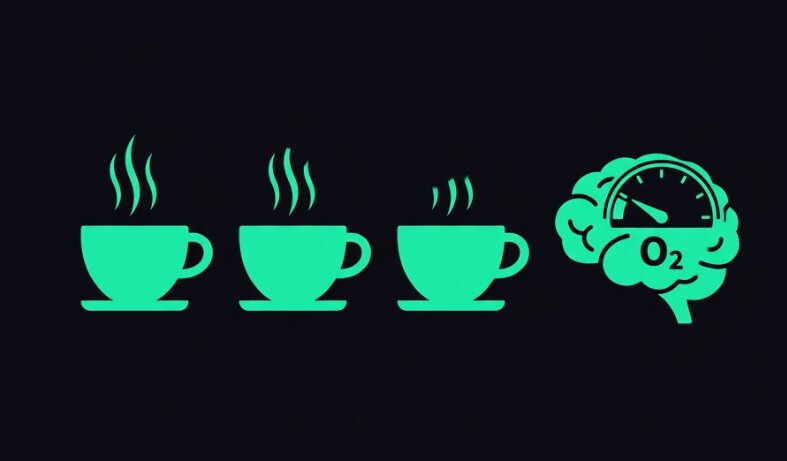
It is 2:17 PM. You have had a productive morning. You crushed your inbox, finished a report, got through three focused work blocks. And then, somewhere between lunch and now, a heavy grey fog rolled in.
You are staring at the screen. The words are blurring. You have read the same sentence four times. Your body feels like it is filled with wet concrete.
You reach for another coffee. You tell yourself to push through. You assume you are just being lazy.
You are not being lazy. Your brain is doing exactly what evolution programmed it to do.
What Is the 2PM Brain Crash — and Why Does It Happen to Everyone?
The afternoon energy slump — sometimes called the postprandial dip, the circadian trough, or just the 2PM wall — is one of the most well-documented patterns in human physiology. It typically hits between 1PM and 3PM, and it happens to virtually everyone, regardless of how much sleep they got or how healthy their lunch was.
The cause is your circadian rhythm. Your body runs on a 24-hour internal clock, and that clock has two low-energy windows built in: one at night (when you sleep), and a smaller one in the early afternoon. Researchers believe this secondary dip may be a vestigial echo of afternoon napping behaviour that is still common in many cultures — the Spanish siesta, for instance, is not a cultural quirk. It is biology.
During this window, your core body temperature dips slightly, melatonin briefly rises, and alertness measurably drops. This happens whether you eat lunch or not.
The afternoon slump is not a personal failing. It is a scheduled physiological event.
Why Lunch Makes It Worse
Food does not cause the slump — but it absolutely amplifies it.
When you eat a large or carbohydrate-heavy meal, your body shifts blood flow toward your digestive system. The process of digesting food triggers a release of insulin, which drives tryptophan into the brain, where it converts to serotonin and then to melatonin. The result: a natural sedation signal that lands at exactly the wrong moment.
This is why a big pasta lunch feels like a tranquiliser dart by 2:30PM. The meal did not create the trough — it deepened it.
A lighter, protein-rich lunch can reduce the severity. But it cannot eliminate the dip entirely, because the dip is circadian, not digestive. You are working against your own biological clock.
What Sitting Does to the Crash
Here is the part most productivity advice leaves out entirely.
Prolonged sitting makes the afternoon slump dramatically worse. When you have been seated for several hours, blood circulation slows, oxygen delivery to the brain decreases, and levels of BDNF — a neurotrophic protein that supports focus and alertness — begin to fall.
Research from multiple large-cohort studies has confirmed that prolonged unbroken sitting is associated with measurably worse executive function, attention, and memory. And by early afternoon, most desk workers have already been sitting for four to six hours.
The 2PM crash is not just a circadian event. It is a circadian event landing on a body that has been still for half a day.
The two effects compound each other. Your biology is telling you to rest, and your stagnant, oxygen-starved body has nothing in reserve to fight it.
Why Caffeine Is the Wrong Tool
Coffee feels like the obvious fix. And it does work — for a while.
The problem is that caffeine works by blocking adenosine receptors in your brain. Adenosine is the chemical that creates the sensation of sleepiness; caffeine masks it rather than clearing it. When the caffeine wears off — typically two to four hours later — the accumulated adenosine floods back in all at once. The crash that follows is usually worse than the one you were trying to avoid.
Caffeine also raises cortisol, which disrupts sleep quality that night. Which means you arrive at tomorrow's 2PM window with more sleep debt, a more severe dip, and a stronger craving for another coffee. It is a cycle that erodes your baseline.
Caffeine delays the crash. Movement eliminates it.
The Fix: Three Minutes of Exercise
Here is what the research actually shows works.
A 2024 study published in npj Mental Health Research found that even three minutes of brief physical activity during prolonged sedentary periods produced significant improvements in both cognitive arousal and mood. Not thirty minutes. Not a gym session. Three minutes.
The mechanism is straightforward: movement increases blood flow to the prefrontal cortex, triggers a release of dopamine and norepinephrine, and reverses the physiological stagnation that makes the afternoon crash so brutal.
A short burst of squats, jumping jacks, or even a brisk walk around the building does what no coffee can: it actually clears the adenosine build-up and restores genuine alertness, rather than masking it.
The key word is during — the break needs to be active to produce this effect. Scrolling your phone or sitting in a different chair does not move enough blood to shift your neurochemical state.
Your body is not asking for more caffeine. It is asking to move.
Try This Right Now
If you are reading this in the 1PM–3PM window and you can already feel the fog setting in, do this before you read the next section:
- Stand up from your chair.
- Do 15 bodyweight squats. Slow and controlled.
- Shake out your legs and take three deep breaths.
Notice what happened to the fog.
That took under two minutes. The restoration of blood flow and the brief spike in heart rate just did more for your afternoon alertness than your next cup of coffee would have.
Ready to stop fighting the afternoon wall?
Start Your Free PomoFit Timer
Building It Into Your Day Automatically
The real challenge with active breaks is not doing them — it is remembering to do them when you are deep in work. By the time you notice the fog, you have usually been in it for forty minutes already.
This is exactly what PomoFit solves. Every focus session ends with an automatically assigned exercise break — squats, push-ups, stretches, jumping jacks — timed and queued before you have even finished your pomodoro. You do not decide what to do, and you do not forget. The active break fires automatically at the right interval, before the crash has a chance to fully land.
The best time to fight the 2PM brain crash is 25 minutes before it starts.